
Claude acts as the whole app instead of writing it.
Write an idea, use it by hand within minutes, and when you like it, get a build plan and the prompts to make it for real.



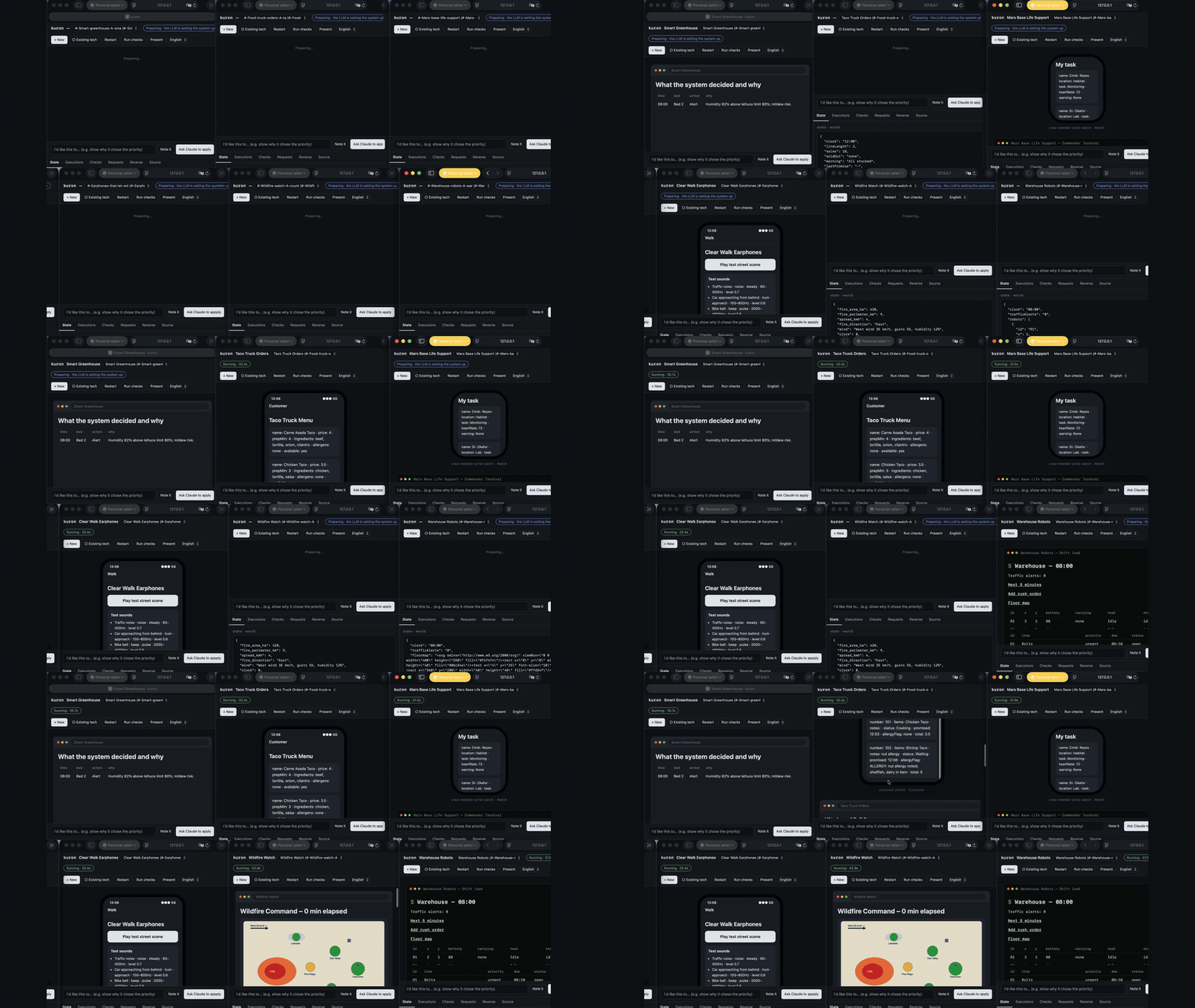
Six ideas pasted at once, each running as a whole system. ▶ Watch the 2-minute video · A recorded run with every tool call
No install. It runs on your own claude.ai account.
I'm a student and a solo developer. AI already makes prototypes many times faster to build, but picturing ideas and market needs only in your head or in a plan is hard for one person. A mockup doesn't help much: the screens are the easy part, and what decides whether an idea is useful is the behaviour behind them.
So kuron reverses the order. Try the idea first, with something that really works, then build it. The name comes from the Japanese word 空論 (kūron), "armchair theory".
- Write the idea in plain words, in any language. One line is enough; a page is fine.
- Use it. Claude sets up minimal screens for each device or role, then plays everything that normally takes longest to build: the backend, the data and the wiring between screens. Every button press is handled by Claude acting as the system. No app code is generated.
- Reverse it. When you like what you see, kuron writes a spec from what the system actually did, a schedule, and the prompts to give a coding agent to build the same thing. For the clinic in the Japanese video, that came to about 92 hours.
idea ─▶ setup (LLM + tools) ─▶ brief · data · screens · timers · checks · existing-tech estimate
                                        │
button / timer / picture / sound ─▶ the LLM acts as the system ─▶ reads what it needs, changes the shared world
                                        │
"this should…" ─▶ the LLM changes its own screens, data and brief
                                        │
                        world.json ◀────┘ ─▶ minimal screens: website, phone, desktop, IoT panel, watch, terminal…
- Many devices, one world. A reception tablet, a doctor's PC, a patient's phone and a waiting-room board all show the same data, so one action shows up everywhere.
- Change it in words. "Show why each patient got their urgency" — Claude rewrites its own screens and behaviour.
- Existing tech switch. An LLM makes every idea look easy. Claude estimates, for each action, what a version you could ship today would use (plain code, a model, an outside service, or not possible yet), how often it would be wrong and how slow it would be, and the prototype then behaves that way.
- Checks. Scenarios of a person using the system, played on a copy of it and judged.
- Reverse. A spec with what the system actually did as golden examples, a schedule, and prompts for a coding agent.
- Real-world parts. Test sounds, sound shaping for earphones, speech, drawings, pictures.
| UI / app generators (Lovable, v0, Figma Make…) | kuron | |
|---|---|---|
| What you get | Screens and application code | Minimal screens; the LLM performs the behaviour live |
| Judgement and back-end logic | Must be coded; prototypes usually fake it | The LLM actually decides (triage, recommendations, routing, estimates) |
| Technology that does not exist yet | Nothing works until it is connected | The LLM plays that part |
| Several roles and devices | Built screen by screen | They share one world |
| Changing it | Edit the code | Say "this should…" |
| Can it really be built? | You find out by building it | Every action is estimated, and the switch lets you feel it |
| What you take away | The code | A spec, golden examples and a build plan with prompts |
Not a good fit: production use (an action takes several seconds and a few cents, and results vary slightly), pixel-level UI design, anything real-time like games, bulk exact data processing.
npx github:Ag3497120/kuron tryThis copies the examples into ./kuron-examples and opens http://127.0.0.1:4870/. You need Node.js 20+ and one of: a
logged-in Claude Code, an API key from a provider below, or Ollama.
| Model name | Runs on | Needs |
|---|---|---|
claude-… (default) |
Claude Code (claude -p, tools as an MCP server) |
a logged-in Claude Code |
anthropic:<model> |
Anthropic API | ANTHROPIC_API_KEY |
openai:<model> |
OpenAI, or any compatible server via KURON_OPENAI_BASE_URL |
OPENAI_API_KEY |
gemini: · openrouter: · groq:<model> |
that provider's OpenAI-compatible API | GEMINI_API_KEY · OPENROUTER_API_KEY · GROQ_API_KEY |
lmstudio:<model> |
LM Studio on this machine | nothing |
| anything else | Ollama on this machine | Ollama |
kuron try --preset anthropic                                       # Anthropic API
kuron try --compile-model openai:<model> --cpu-model openai:<small> # any provider
kuron dev .                    # every .kuron idea in a folder; "+ New" from one line
kuron new "a clinic that …"    # write an idea and set it up
kuron check idea.kuron         # play the system's checks
kuron hands --url <host>       # the tools as an MCP server, for any MCP client
Browser version vs local: the browser version needs nothing but a claude.ai login; it has no microphone and runs timers when
you press them. Its source is in web/ (node tools/build-web.mjs).
| Code contains | Code never contains |
|---|---|
| Generic tools (store and read data, define screens, notify, sound, speech, drawings, timers, checks, estimates), a shape check on every tool call that answers in words, a minimal renderer | Business judgement, word lists, guessing what the LLM meant, exceptions for one idea |
When something does not fit, a tool tells the LLM what is wrong and the LLM corrects itself. When a prototype behaves wrongly, you tell it how it should behave. See docs/DESIGN.md.
kuron needs more ideas to be tested on, especially ones that break it. Add yours as examples/<name>.kuron in a pull
request, or open an issue with what worked and what broke (the browser version's Feedback button does that for you).
See CONTRIBUTING.md.
MIT